Sample No. 0236
17 Crafting Truths About Creative Stashes, Unfinished Projects and Making Time
A warm, candid look at the joys and frustrations of crafting, from saved paper and crowded workspaces to creative work, community and taking breaks.
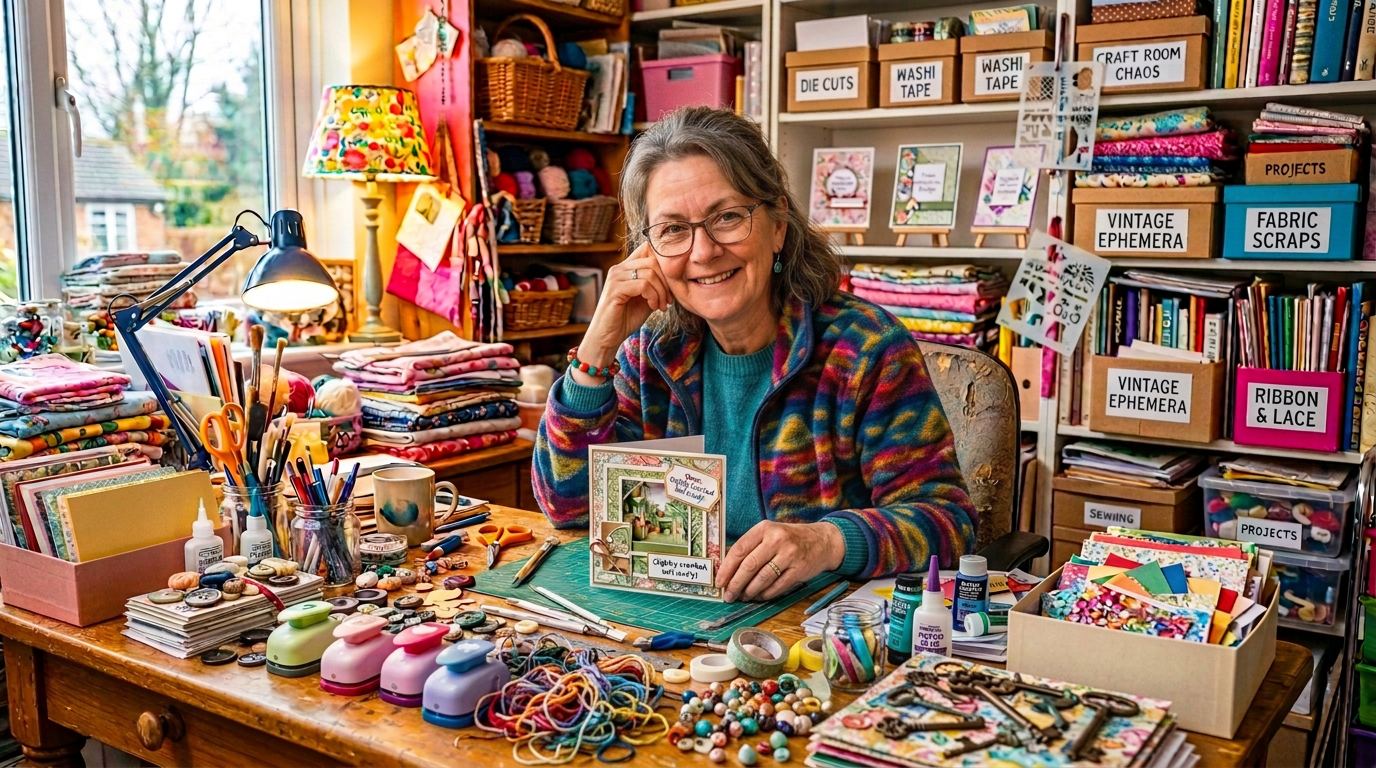
Crafting can be calming, absorbing and wonderfully satisfying. A few sheets of paper, a length of ribbon or a handful of embellishments can become a gift that makes someone smile. But the hobby has its less polished moments, too: supplies we forget we own, projects that wait for years, and storage that seems to invite yet another shopping trip.
These habits don’t make anyone a bad crafter. They’re familiar knots in the creative process, and sometimes a laugh is enough to loosen them. A little honesty can also help us make more of the materials we have, protect the pleasure of making and find our way back to projects we’ve set aside.
The stash has a memory problem
It’s easy to bring home a new stamp set, ink colour or roll of ribbon, only to find the same item tucked away at home. We bought the first one because it seemed perfect, then placed it somewhere so safe that it disappeared from memory. Months later, the second one joins it.
Keeping a list or catalogue could prevent repeat purchases. Yet taking stock means facing the full size of the collection, and that can feel like a project in itself. A simple inventory of favourite tools and frequently replaced materials may be a gentler start than documenting every scrap and embellishment. Even a quick look through a drawer before shopping can save a duplicate.
Beautiful paper deserves to become something
Some patterned paper is so lovely that cutting it feels almost wrong. The colour, texture, design and even scent can make a sheet seem too precious to use. It gets admired, fanned across the desk and slipped back into its protective wallet while the project waits for a less special piece.
That’s a charming problem, until the collection becomes a gallery of untouched sheets. The paper was designed to be made into something. Using it doesn’t diminish its beauty; it gives that beauty a new purpose. If a full sheet feels like too much to begin with, a small piece can become a card panel, a tag or an accent. The occasion doesn’t need to be grand. Making something today is reason enough to open the packet.
More supplies can mean more decisions
A full range of inks, dies, stamps and cardstock seems to promise endless possibilities. In practice, too many choices can stall a session. We search for one stamp, compare paper options, then discover the glue we meant to use has dried out. Forty minutes of choosing can pass before anything gets cut.
Limits can help creativity get moving. Try picking a small group of materials before starting, or choose one colour family and one tool to guide the project. Working with what’s close at hand can make a decision easier and reveal combinations we might overlook while browsing the whole stash. And if the room needs a tidy, a short reset may be all that stands between a good idea and a workable table.
A handmade project carries more than its materials
It’s tempting to say a handmade card costs very little: just paper, glue and a few embellishments. That calculation leaves out the £200 die-cutting machine, £80 collection of stamps, £50 worth of inks and other tools that once seemed essential. Then there’s storage, which takes up space and often costs money of its own.
The cycle is easy to recognise: buy supplies, run out of room, add storage, then enjoy the new space by filling it. The total value of a stash can be difficult to calculate, and there’s no need to turn a hobby into an accounting exercise. Still, being honest about the pattern can help us decide what we want to buy next—and whether a new container is solving a problem or simply making room for more materials.
The same fuller accounting matters when pricing handmade work. A project uses more than its visible ingredients. There’s design time, equipment, packaging, photography, promotion and sometimes several attempts that don’t make it to the finished pile.
Shopping can crowd out making
Finding a new collection, watching a product demonstration or seeing a tool praised in a craft group can be exciting. Buying it brings its own anticipation: the order, the delivery, the unwrapping and the chance to admire a fresh addition. The trouble starts when the next release arrives before the last purchase has left its packaging.
Enjoying craft shopping is part of the hobby for many people. The useful question is whether the excitement of acquiring supplies is taking the place of making. Before ordering, it can help to ask what project the product will serve, whether the same effect is possible with materials already on the table, and whether there’s time to use it soon. There’s no need to make every purchase earn its keep immediately, but a pause can reconnect buying with the pleasure of creating.
The unfinished project collection
A half-knitted jumper, a scrapbook missing three pages, an embroidered picture still in its hoop since 2017, a card waiting for a sentiment: most makers can name something that was meant to be finished later. Starting a fresh project is energising. Returning to one that has sat on a shelf for eighteen months can feel more like homework.
Calling these works a “creative archive” is a funny way to take the sting out of the pile, but it doesn’t decide what happens next. We can choose one project to finish, revise the original plan, or let go of a piece that no longer interests us. If we do want to return, a small next step—a page, a seam, a few rows or the missing message—can make the restart less daunting. There’s no rule that every idea must become a finished object.
Selling handmade work takes more than making it
“You should sell those; you’d make a fortune” is often offered as encouragement. Turning a creative hobby into a business, though, involves much more than producing attractive work. A customer may compare a handmade card with a mass-produced one in a supermarket without seeing the design decisions, materials, equipment, packing, photography or discarded attempts behind it.
Markets can be crowded with similar offerings, making it hard to stand out. After spending four hours on a piece, a maker may hear that someone can buy something similar for £2.50. That can be dispiriting, especially when the price needs to account for skill and time as well as supplies. Explaining the value of handmade work is part of selling, but it can also be tiring. A hobbyist who considers selling should know that making the work is only one part of the job.
When the hobby becomes work
Making a living from a creative skill can be rewarding, but it changes the shape of the activity. A hobby lets us make what we fancy when we feel like it. If inspiration is missing, we can put the project away and try another day.
Paid creative work brings deadlines, customer expectations, promotion, invoices and technical snags. A tutorial may need filming when we don’t feel creative; an order still has to be packed and posted; an article still needs writing. Editing a video about a project that took twenty minutes to make can take three hours. The work may be fulfilling, but it doesn’t turn every day into a relaxed crafting session. Passion can become a profession, and a profession still has its ordinary pressures.
Online pictures leave out the messy middle
Crafting feeds often show tidy desks, carefully arranged supplies and immaculate finished pieces. Real workspaces can include paper scraps, stray tools, glue on clothing and a pet wandering off with a foam blending tool. The gap between those pictures and a maker’s actual afternoon is easy to mistake for a gap in skill.
A polished card photograph doesn’t show the version glued together backwards. A finished quilt doesn’t show the time spent unpicking a seam. A successful resin piece doesn’t reveal the experiments that came first. Sharing a beautiful result is perfectly reasonable, but it’s helpful to remember that the picture is only one moment in the making. Frustration and mistakes belong to creative work, too. They don’t mean we’re doing it wrong.
Look after the hands and shoulders that make things
Creative work can help us relax and lift our mood, but long sessions can be hard on the body. Hunching over a desk, peering at small details, gripping tools or using machinery for hours can leave necks, shoulders and wrists sore, while eyes grow tired. It’s also easy to become so absorbed that we forget to move.
Regular pauses, a stretch and a more comfortable working position can make a session kinder to the body. If a project needs close attention, take a moment to look away and shift posture. A complicated pop-up card may be satisfying, but no handmade birthday greeting is worth a permanent crick in the neck.
Make room for every budget and method
Craft communities are at their best when makers can share what they enjoy without judging one another’s choices. Yet snobbery can appear around brands, prices and techniques. Some people insist only certain labels are worth buying, while others look down on inexpensive materials. One maker may say handmade means doing every step by hand; another may dismiss digital cutting as less creative. Premium tools can draw criticism, too, even when a maker has chosen to spend more.
There’s room for good-quality equipment and modest budgets. Affordable alternatives are not the same as counterfeit goods that copy someone else’s designs. What matters most is the work a person makes and the enjoyment they find in making it. A beautiful project can come from bargain-bin supplies; expensive equipment can’t guarantee a beautiful result. A disappointing experiment is still part of learning.
Give credit when someone’s work inspires you
Sharing projects online can encourage others and connect makers. It also makes it possible for someone to recreate a design. Learning a technique, taking inspiration or following a tutorial shared for that purpose is part of how crafters pass skills along. Directly copying another maker’s original design, selling reproductions as your own or presenting another person’s idea without credit is a different matter, especially when that maker earns a living from their designs.
Similarity alone doesn’t prove copying. Makers may arrive at similar solutions, and no one person owns every possible way to fold a piece of cardstock. Still, acknowledging the person who inspired a project is a small courtesy that helps others find the source of an idea. A simple credit takes little effort and can mean a lot to the maker whose work helped us learn.
Rest is part of a creative life
When we’ve invested time, money and space in crafting, it can feel as though we ought to be using our supplies constantly. A look at the craft room can bring on the thought, “I should be making something,” even when we’re tired, busy or simply not in the mood.
That pressure can turn a relaxing hobby into one more obligation. Creativity isn’t a switch we can always flip on. A quiet spell doesn’t erase our interest or waste the things we’ve bought. Taking a break may be exactly what lets enthusiasm return. The supplies will still be there when we’re ready—and glitter has a way of remaining in the room regardless.
Community can make solitary work feel shared
Crafting groups, workshops, events and online communities give makers plenty of ways to meet. Yet much of the actual work happens alone. For some, that quiet focus is the best part. For others, it can feel isolating when friends and family don’t share the excitement of a crisp stamped impression, a successful machine cut or a pleasing colour combination.
That’s why finding other makers matters. A group of people who understand why a new embossing folder is exciting can turn a solitary pastime into a shared one. They can offer encouragement, trade ideas and appreciate the small victories that might not mean much to someone outside the hobby. They may even understand why a person owns seventeen pairs of scissors.
Organising supplies can become its own project
There’s real pleasure in neatly labelled boxes, ink pads in order and ribbon arranged by colour. A well-organised space can make materials easier to find and invite us to work. But arranging supplies is not the same as using them. It’s possible to spend a whole weekend shifting everything into fresh containers, congratulate ourselves on the improved setup, then forget where we put the tool we need.
Organisation is useful when it helps us get to making. Before a big room rearrangement, we can decide what needs to be easier to reach and choose a simple system that fits the way we work. Labels and visible storage can help, but the best arrangement is one we remember. And if reorganising is a satisfying part of the hobby, that’s fine too—as long as we don’t mistake every tidy shelf for a finished project.
New releases don’t define a good maker
Fresh launches, new tools, limited-time offers and exclusive bundles can create a strong sense that we need to decide immediately. Product demonstrations can be persuasive, especially when they show a tool producing a beautiful result. But the supplies from the last launch may still be unopened on the shelf.
Businesses need customers, and designers deserve to earn a living from their work. At the same time, encouraging creativity is different from encouraging people to buy endlessly. We don’t need every new product to make worthwhile work, or the latest machine to learn a skill. Buying an entire collection because a demonstration makes it seem urgent may leave us with more choices and less time to use them. A pause gives us room to decide whether the item suits the projects we actually want to make.
What would you want to happen to your stash?
Crafting meets us at joyful occasions and difficult ones alike. We make cards and gifts for birthdays, weddings, anniversaries, new babies and celebrations of all kinds. We also make sympathy cards and memorial keepsakes that offer comfort after a loss. Those projects may be hard to create, but they can carry deep meaning.
It’s less comfortable to consider what happens to a collection when its maker is gone. Supplies can represent years of money, time and enthusiasm. We know why a particular stamp set mattered, how hard it was to find a discontinued range and why we saved those scraps of handmade paper. Someone who doesn’t craft may see a room of old paper, plastic boxes and unfamiliar machines, without knowing what should be kept, given away or used.
We can make the task easier by identifying valuable equipment, passing supplies to fellow makers while we’re here to enjoy their enthusiasm, or leaving a little guidance for whoever sorts the collection later. That doesn’t mean we need to worry constantly about what happens in the future. It simply recognises that the stash means something to us and that some of that meaning might be shared.
It also brings us back to the paper we’ve been saving for the perfect occasion. Perhaps the occasion is having the time and opportunity to make something today. Open the packet. Choose a favourite piece. Let it become part of a project.
Enjoy the making, not a made-up standard
None of these habits makes us terrible crafters. They’re simply part of a hobby that can be generous, messy, costly, sociable and occasionally frustrating. Crafting isn’t a contest to own the most expensive tools, finish the most projects or keep the tidiest room. It’s a chance to be curious, learn a skill, make mistakes and enjoy the moment when an idea comes together.
We may buy a few too many rolls of ribbon, start more projects than we finish, or keep a beautiful sheet of paper tucked away. We can meet those habits with humour rather than guilt. If something here feels familiar, pick one small change: check the stash before shopping, take a break during a long session, credit a maker who inspired you or use a supply you’ve been saving.
Then make something in the way that suits you, with the materials you have and the time you can give. The paper, thread, tools and glitter will be ready when you are.
Share the love!
If you find this post fun, entertaining or useful, please do consider sharing it to your fave social platform using the handy buttons below.
- Share on Facebook (Opens in new window)Facebook
- Share on X (Opens in new window)X
- Share on Bluesky (Opens in new window)Bluesky
- Share on Pinterest (Opens in new window)Pinterest
- Share on Tumblr (Opens in new window)Tumblr
- Share on Reddit (Opens in new window)Reddit
- Share on Telegram (Opens in new window)Telegram
- Share on Mastodon (Opens in new window)Mastodon
- Share on Mail (Opens in new window)Mail
- Share on Threads (Opens in new window)Threads


John.