Sample No. 0278
Joseph Moxon and the Practical Knowledge Behind Mechanick Exercises
Printer and maker Joseph Moxon recorded seventeenth-century craft skills in Mechanick Exercises, including joinery methods and tools still familiar to woodworkers.

Joseph Moxon’s lasting value to craftspeople lies in how he documented working knowledge. His Mechanick Exercises describes tools and trades from seventeenth-century England, offering readers a chance to study how practical skills were understood and carried out in his time. For hand-tool woodworkers especially, the sections on joinery make the book a record of working methods as well as an absorbing historical resource.
Moxon (1627–1691) brought experience across a striking range of work to that task. He was a printer, mapmaker and maker of mathematical instruments, and he had knowledge of joinery, carpentry, blacksmithing, turning and bricklaying. That breadth matters: the book reflects a world in which skilled trades overlapped, and where familiarity with tools and materials could extend well beyond a single specialty.
A life among books, maps and instruments
Born in England in August 1627, Moxon grew up watching his father print books. He spent part of his childhood in the Netherlands before moving to London, where he opened a shop. There he sold books he printed, globes and maps he made, and mathematical instruments he built.
His work gained recognition from King Charles II, who gave Moxon the title of hydrographer. In 1678, Moxon also became a fellow of the Royal Society. These details place him among makers whose practical work and technical knowledge connected with the intellectual life of the period.
His skills included smithing, founding, drawing, joinery, turning, engraving, printing, globe and mapmaking, and instrument making. Moxon’s range calls to mind the kind of versatile craft knowledge that develops through doing: understanding how a tool works, how material behaves, and what a particular job demands. His manual brought that knowledge into a form readers could return to and study.
A book published in instalments
Moxon began publishing Mechanick Exercises in January 1677. Rather than appearing all at once, it came out in monthly instalments that readers could collect and later have bound into volumes. The first volume contained fourteen numbered issues, published from 1677 to 1680, and covered several trades.
A second volume began publication in 1683 and focused entirely on printing. It comprised twenty-four numbered sections on different aspects of that trade. The two volumes therefore offer distinct kinds of insight: the first ranges across skilled work, while the second concentrates on the processes and tools involved in printing.
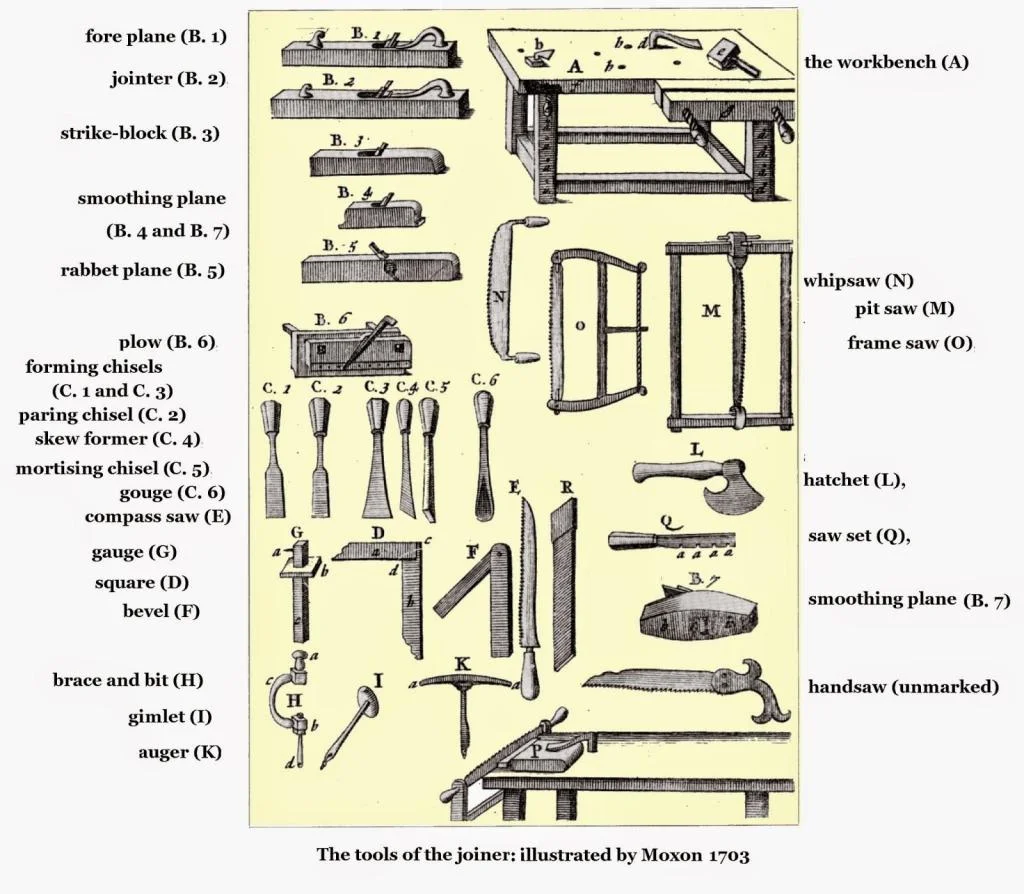
Joinery, tools and a familiar vice
For today’s hand-tool woodworker, The Art of Joinery is one of the most useful parts of the work. Moxon discusses the tasks a joiner undertook, along with woodworking tools and working practices. Experienced hand-tool and hybrid woodworkers may recognize many of the subjects, while newer makers can use the descriptions to build familiarity with the craft and its tools.
The book’s treatment of a double-screw vice has drawn particular interest from modern woodworkers. Moxon explains that it could sit on top of a bench and be held in place with two holdfasts. That arrangement is associated with what woodworkers now call a Moxon vice. The name shouldn’t be taken to mean Moxon invented it: the account describes the vice and its use, but does not establish him as its inventor.

This distinction is a useful reminder when studying historical tools. A written description can show how a device was used and understood without revealing who first designed it. Moxon’s contribution is his record of the tool in a working setting, including how it could be secured for use.
What the record offers makers now
Mechanick Exercises lets readers examine the tools and working practices of tradespeople in seventeenth-century England, then compare them with techniques still used by hand-tool woodworkers. The bricklaying tools illustrated in the book are especially striking to the writer: their forms appear much the same as those used today. That observation points to the staying power of a tool design that served its purpose well across generations.
The book’s value extends beyond any single tool. Much practical skill was traditionally learned through years of working alongside an experienced craftsperson. Moxon’s descriptions preserve some of that knowledge in written form, giving readers a way to inspect methods and equipment that might otherwise be difficult to encounter directly.
Historical texts can also offer a useful counterpoint to modern descriptions of old techniques. They give makers a chance to consider period tools and practices through the words of someone with first-hand knowledge of several trades. Readers can compare those accounts with the methods they use today, paying attention to what has endured and what the record can teach about how craftspeople approached their work.
Moxon’s book rewards patient reading: start with the trade that interests you, follow its tools and working practices, and compare them with your own experience. His writing keeps the attention on the work itself, making Mechanick Exercises a practical window into the skills of its time.